

Interactive technologies are drawing growing interest in research on interventions for people living with Alzheimer's disease. Digital games, interactive projections and immersive environments are being studied in particular for their potential to provide cognitive, motor and social stimulation.
But what do the scientific studies actually tell us?
Encouraging results for cognitive stimulation
A systematic review published by Cochrane in 2023, covering 37 studies and 2,766 participants living with mild to moderate dementia, concluded that cognitive stimulation interventions probably lead to slight improvements in cognitive function, with some possible benefits for well-being and daily activities.
These findings support the value of structured stimulation approaches, even though they do not relate exclusively to digital technologies.
Research focusing specifically on interactive games also provides interesting results.
In 2024, a meta-analysis published in JMIR Serious Games, covering 14 randomized controlled trials and 714 participants living with Alzheimer's disease or mild cognitive impairment, observed significant improvements in cognitive performance and in some functional abilities among people using therapeutic digital games.
The authors note, however, that sample sizes and the methodological quality of the studies limit the scope of these conclusions.
When technology combines cognitive and motor stimulation
Interactive technologies make it possible to engage several functions at once through real-time visual and auditory feedback.
A meta-analysis published in 2025 in Age and Ageing, covering 28 trials and 1,698 participants with mild cognitive impairment, notably found improvements in executive function, attention and global cognition with digital games.
However, no statistically significant improvement in memory or quality of life was demonstrated in this analysis.
These results highlight the importance of distinguishing between the different cognitive functions assessed, as well as the populations studied.
Practical applications in care settings
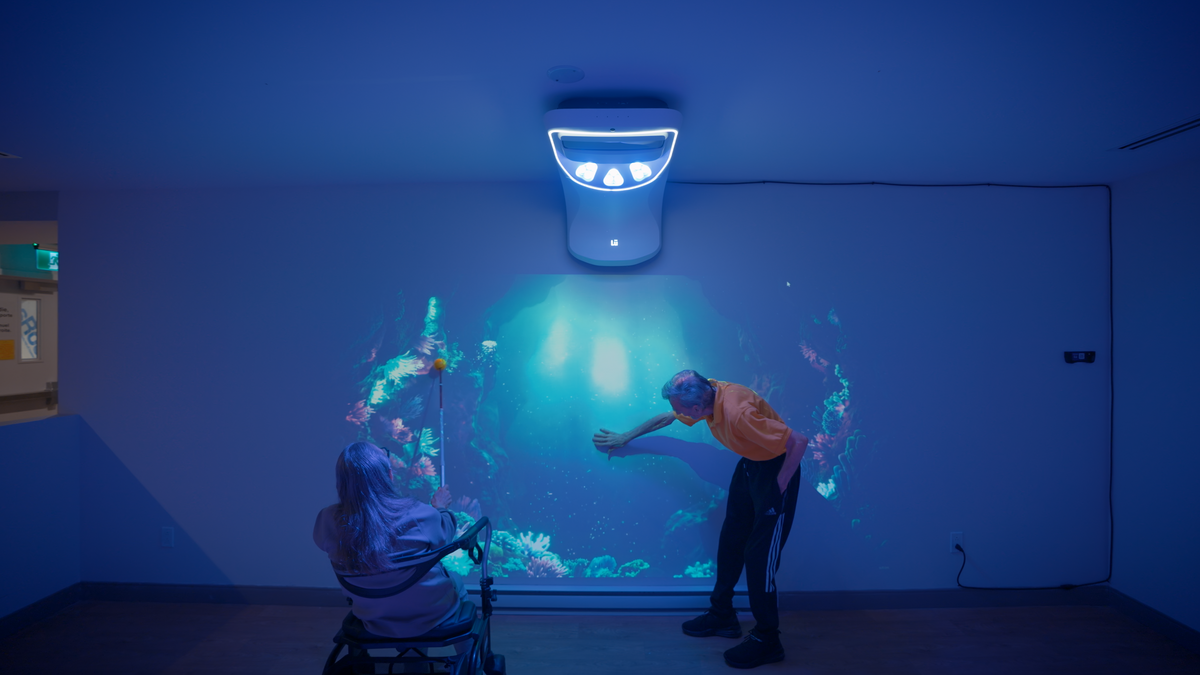
Interactive projection systems, such as the Höp developed by Lü, illustrate this new generation of tools. Using motion detection, they allow participants to interact with elements projected onto various surfaces, without a controller.
This type of environment can be used to offer activities that call on visual attention, hand-eye coordination, voluntary movement and social interaction.
The appeal of these systems lies especially in their accessibility and in the ability to adapt activities to individual abilities.
It is important to note, however, that the results of studies on digital games cannot be directly attributed to the Höp without a specific clinical evaluation.
Towards evidence-based integration
Current research suggests that interactive technologies can be a valuable complement to existing non-pharmacological interventions.
Their effectiveness nonetheless depends on several factors: the cognitive profile of participants, the frequency of sessions, the nature of the activities and the quality of the support provided.
Beyond technological innovation, the true potential of these tools lies in their ability to offer experiences that are adapted, engaging and person-centred.
For example, interactive projection systems such as the Höp, developed by Lü, can turn a wall into an interactive environment. Participants can then virtually manipulate projected elements with simple hand movements.
Session length, activity complexity and stimulus intensity should nonetheless be adjusted to each person's needs and reactions.
An approach that complements existing interventions
These technologies do not replace traditional approaches, but they can enrich activity programming by combining cognitive stimulation, movement and social interaction.
They are also valuable for care teams, who can vary the ways residents participate and observe their reactions in different contexts.
While research on digital and multisensory interventions is encouraging in some contexts, results remain variable depending on the technologies, populations and objectives studied. Further studies are needed to establish their long-term effects.
The challenge, then, is not simply to bring more technology into care settings, but to use it thoughtfully to create accessible, adapted and meaningful experiences for each person.
References
1. Cochrane (2023). Cognitive stimulation to improve cognitive functioning in people with dementia.
37 studies, 2,766 participants.
https://doi.org/10.1002/14651858.CD005562.pub3
2. Zuo et al. (2024). Effects of Electronic Serious Games on Older Adults With Alzheimer's Disease and Mild Cognitive Impairment.
JMIR Serious Games, 14 trials, 714 participants.
https://doi.org/10.2196/55785
3. Gao and Liu (2025). Effects of digital technology-based serious games interventions for older adults with mild cognitive impairment.
Age and Ageing, 28 trials, 1,698 participants.
https://doi.org/10.1093/ageing/afaf080


